
04 Sep How Does UV Printing Work?
The Complete Guide to UV Printing Technology
How Does UV Printing Work? UV printing works by using ultraviolet (UV) light to instantly cure or dry UV-curable inks as they are printed onto a surface. Unlike conventional printing where ink dries slowly through evaporation or absorption, UV printing uses a photochemical process called photopolymerisation — where liquid ink is transformed into a solid, durable film in milliseconds the moment it is exposed to UV light. This instant curing creates prints that are scratch-resistant, waterproof, and fade-resistant on virtually any material including plastic, glass, metal, wood, ceramic, acrylic, and leather. At Krayon Enterprises in Nairobi CBD, we specialise in professional UV printing services that deliver exceptional quality and durability on pens, bottles, trophies, phone cases, and more. WhatsApp +254 722 376 151 for a quote.
The UV Printing Process: Step-by-Step
Step 1: Digital Design Creation
The process begins with creating or preparing your digital design using graphic design software. The digital file tells the printer exactly where to place each droplet of ink.
Step 2: File Processing (RIP Software)
Before printing, the digital file is processed through RIP (Raster Image Processing) software. This software converts the digital file into a format the UV printer can understand, including controlling how much ink is used and determining where to place white ink or varnish (if required).
Step 3: UV Ink Application
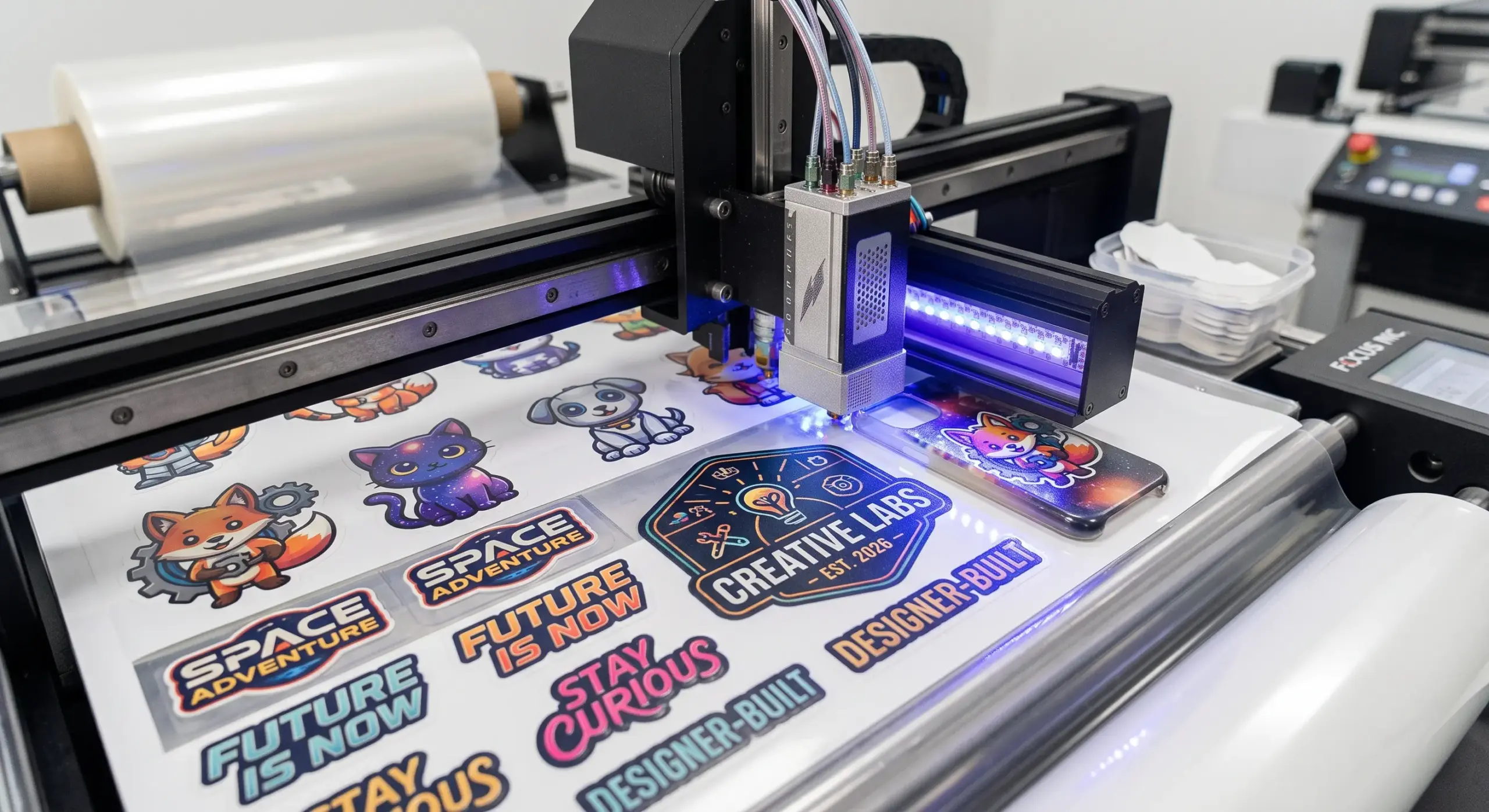
Using piezoelectric printheads, the UV printer deposits microscopic droplets of UV-curable ink onto the substrate (the material being printed on). Unlike thermal inkjet printers that use heat, piezoelectric printheads use electrical pulses to control ink flow with exceptional precision.
Step 4: UV Curing (The Key Step)
As the ink is deposited, UV LED lamps — typically operating in the 395–405 nm wavelength range — shine ultraviolet light directly onto the wet ink. This triggers photopolymerisation, a chemical reaction that instantly hardens the ink:
-
Photopolymerisation is a chemical process where UV light acts as a catalyst, causing the ink’s liquid monomers and oligomers to cross-link and form a solid, durable polymer chain.
-
This reaction happens in milliseconds, transforming the liquid ink into a solid film.
-
The ink does not evaporate or soak into the substrate — it bonds directly to the surface.
Step 5: Ink Deposition and Curing Sequence
UV printers are equipped with multiple printheads or a system where printing and curing happen simultaneously. The forward and return pass of the printhead both cure the ink, eliminating any drying time.
Step 6: Finished Print
The print is fully cured and ready for immediate handling the moment it leaves the printer. There is no drying time required, and the print is instantly scratch-resistant, waterproof, and durable.
The Science Behind UV Printing: Photopolymerisation
Photopolymerisation is the chemical reaction that powers UV printing. Here’s how it works in detail:
What Is Photopolymerisation?
Photopolymerisation is a chemical process where light (specifically UV light) triggers a chain reaction that transforms liquid monomers and oligomers into solid polymer chains.
How It Works in UV Printing:
-
Ink Formulation: UV-curable inks contain three key components:
-
Monomers and Oligomers: The building blocks that will form the solid polymer
-
Photoinitiators: Chemicals that absorb UV light and trigger the polymerization reaction
-
Pigments: Provide colour
-
-
UV Light Exposure: When UV light hits the wet ink, the photoinitiators absorb the light energy.
-
Chemical Reaction: The photoinitiators break down into free radicals — highly reactive molecules that start a chain reaction.
-
Polymerisation: The free radicals cause the monomers and oligomers to link together, forming long, solid polymer chains.
-
Instant Curing: The liquid ink transforms into a solid film in milliseconds. The reaction is complete — no further drying or curing is needed.
Why This Matters:
Because photopolymerisation transforms liquid ink into a solid film that bonds to the surface rather than soaking into it, UV printing can work on virtually any material — including non-porous surfaces like glass, metal, and plastic that traditional inks would bead up on or simply wipe off of.
The Evolution of UV Printing Technology
UV curing technology has evolved significantly over the years:
1. Mercury Arc Lamps (Traditional UV Curing)
Early UV printers used mercury arc lamps to cure UV inks. While effective, these lamps had several drawbacks:
-
Short lifespan (typically 1,000 hours)
-
Very high energy consumption
-
Bulky size and large footprint
-
Expensive to maintain and replace
-
Produced significant heat, limiting material options
2. UV LED Technology (Modern UV Printing)
Modern UV printers use UV LED (Light Emitting Diode) lamps, which offer significant advantages:
-
Long lifespan: 10,000 to 30,000 hours — significantly longer than mercury lamps
-
Low energy consumption: Much more energy-efficient
-
Compact size: Smaller and more precise
-
Low heat output: Allows printing on heat-sensitive materials
-
Instant on/off: No warm-up or cool-down time
-
Environmentally friendly: No ozone generation or mercury contamination
Key Components of a UV Printing Machine
1. Piezoelectric Printheads
Unlike thermal inkjet printheads that use heat to eject ink, piezoelectric printheads use electrical pulses to control ink flow. This allows for:
-
More precise droplet control
-
Higher resolution printing
-
Better reliability and longer lifespan
2. UV LED Lamps
Modern UV printers use UV LED lamps operating in the 395–405 nm wavelength range. These lamps:
-
Cure ink instantly
-
Generate minimal heat
-
Consume less energy
-
Last much longer than traditional lamps
3. Ink Delivery System
UV printers have a sophisticated ink delivery system that includes:
-
CMYK (Cyan, Magenta, Yellow, Black) inks
-
White ink for printing on dark or transparent surfaces
-
Varnish/Gloss ink for special effects
-
Ink circulation system to prevent settling and clogging
4. Substrate Handling System
Depending on the printer type, this can include:
-
Flatbed for rigid materials (glass, acrylic, metal, wood)
-
Roll-to-roll for flexible materials (vinyl, banners, fabric)
-
Hybrid systems that handle both
UV Printing vs. Traditional Printing: The Key Differences
| Feature | UV Printing | Traditional Printing |
|---|---|---|
| Drying Process | Photopolymerisation — chemical reaction | Evaporation or absorption |
| Ink Type | UV-curable ink — 100% solids | Solvent or water-based — contains solvents |
| Drying Time | Instant — milliseconds | Minutes to hours |
| Ink Adhesion | Bonds to surface, doesn’t soak in | Soaks into or evaporates from surface |
| Ink Film | Forms a solid, durable layer on the surface | Ink penetrates the substrate |
| Substrate Range | Almost any material | Paper and limited materials |
| Durability | Scratch-resistant, waterproof, fade-proof | Prone to smudging, fading, water damage |
| Environmental | No VOCs, eco-friendly | Contains VOCs, solvent emissions |
| Heat Generation | Minimal (LED) or moderate (mercury) | None or minimal |
Why UV Printing Is Superior
1. Dries Instantly
The most obvious difference is the speed of curing. Traditional printing can take minutes or even hours for ink to fully dry. UV ink cures instantly, meaning:
-
No waiting time
-
No smudging or offsetting
-
Immediate handling and finishing
-
Faster production times
2. Bonds to the Surface, Not Into It
Traditional inks soak into the substrate and evaporate, leaving a thin ink layer on the surface. UV inks bond directly to the surface through chemical adhesion, making them:
-
More durable
-
More scratch-resistant
-
Waterproof
3. Works on Virtually Any Material
Because UV inks don’t need to soak into the substrate, they work on materials that traditional printing can’t handle:
-
Plastic
-
Glass
-
Metal
-
Wood
-
Ceramic
-
Acrylic
-
Leather
-
And more
4. More Vibrant, Saturated Colours
Because UV inks sit on the surface rather than soaking in, they produce more vibrant and saturated colours. The white ink layer allows printing on dark and transparent materials.
5. Environmentally Friendly
UV inks contain no volatile organic compounds (VOCs), making them more environmentally friendly than solvent-based inks.
6. No Heat Damage
UV LED printing generates minimal heat, allowing printing on heat-sensitive materials like thin plastics and certain fabrics.
Types of UV Printing
1. UV Flatbed Printing
UV flatbed printers print directly onto rigid materials placed on a stationary flat bed. The print head moves across the material, depositing ink and curing it instantly.
2. UV Roll-to-Roll Printing
UV roll-to-roll printers print on flexible media that feeds through the machine on rolls. Ideal for high-volume production of banners, stickers, and flexible signage.
3. UV DTF Printing
UV DTF (Direct-to-Film) printers print designs onto special A-film and B-film roll materials using UV-curable inks. The printed film is then transferred onto hard surfaces using pressure — no heat required.
4. UV Hybrid Printing
UV hybrid printers combine flatbed and roll-to-roll capabilities in one machine. They can print on both rigid materials and flexible media.
Applications of UV Printing
UV printing is used across virtually every industry:
Corporate Branding
Branded promotional products, corporate gifts, employee recognition items, office signage
Retail
Phone cases, drinkware, accessories, gift items, packaging
Hospitality
Branded glassware, mugs, promotional items, signage, menus
Events
Branded merchandise, giveaways, promotional materials, event signage
Education
Student merchandise, team apparel, fundraising items, recognition awards
Manufacturing
Product identification, serial numbers, logos, branding on industrial components
Frequently Asked Questions
How does UV printing work?
UV printing works by using UV light to instantly cure UV-curable inks as they are printed onto a surface. The UV light triggers a chemical reaction called photopolymerisation, transforming liquid ink into a solid, durable film in milliseconds.
What is the UV printing process?
The UV printing process involves: 1) digital design creation, 2) RIP software processing, 3) ink application via piezoelectric printheads, 4) instant UV curing via UV LED lamps, and 5) immediate handling of the finished print.
What is photopolymerisation in UV printing?
Photopolymerisation is a chemical reaction where UV light acts as a catalyst, causing the ink’s liquid monomers and oligomers to cross-link and form a solid, durable polymer chain. This reaction happens in milliseconds.
Is UV printing better than regular printing?
Yes. UV printing is more durable, waterproof, scratch-resistant, and fade-resistant than regular printing. It also works on a wider range of materials.
Why does UV ink cure instantly?
UV ink cures instantly because the UV light triggers a photopolymerisation reaction that transforms liquid ink into a solid film in milliseconds — no drying time is needed.
What surfaces can UV printing be used on?
UV printing works on virtually any material including plastic, glass, metal, wood, ceramic, acrylic, leather, and more.
How do UV LED lamps work in printing?
UV LED lamps emit light in the 395–405 nm wavelength range. This UV light triggers the photopolymerisation reaction that instantly cures the ink.
Is UV printing environmentally friendly?
Yes. UV inks contain no volatile organic compounds (VOCs), making them more environmentally friendly than solvent-based inks.
What is the difference between UV printing and screen printing?
UV printing uses UV light to cure ink instantly and prints digitally from a file. Screen printing uses stencils and squeegees to push ink through screens. UV printing has no setup costs, no minimum order, and supports full-colour designs.
Do you need special inks for UV printing?
Yes. UV printing requires UV-curable inks that contain photoinitiators — chemicals that react to UV light and trigger the photopolymerisation process.
Why Choose Krayon for UV Printing in Nairobi
At Krayon Enterprises, located at Lords House near Khoja Roundabout in Nairobi CBD, we specialise in professional UV printing:
-
Premium Quality — Advanced UV printing technology for vibrant, durable results
-
Affordable Pricing — From KSh 100 per item
-
No Minimum Order — From a single item to bulk production
-
Same-Day Turnaround — Available for urgent orders
-
Professional Application — We print directly onto your products
-
Expert Design Support — Assistance with artwork and colour matching
-
Wide Product Range — Branding on pens, bottles, phone cases, trophies, and more
Get Started with Krayon Today
Ready to experience professional UV printing in Nairobi? At Krayon, we combine technical expertise, premium quality, and exceptional customer service to deliver UV printing that impresses and lasts.
Contact Us
📱 WhatsApp us: +254 722 376 151
📍 Location: Lords House near Khoja Roundabout, Nairobi CBD, Kenya
📞 Phone: +254 722 376 151
📧 Email: sales@krayon.co.ke | info@krayone.com
🌐 Website: krayon.co.ke
Get a Quote
Ready to create professional UV prints for your business? Chat with us directly on WhatsApp for pricing, turnaround time, and minimum order quantities.
WhatsApp us: +254 722 376 151
No Comments