05 Sep Screen printing vs UV printing
Screen Printing vs UV Printing: The Complete Comparison Guide
Screen printing vs UV printing — which printing method is right for your business? The answer depends on your project requirements, quantity, budget, and materials. Screen printing is a traditional method that pushes ink through mesh screens onto fabric or paper, making it ideal for large-volume orders of t-shirts, posters, and apparel. UV printing is a modern digital process that uses ultraviolet light to instantly cure ink onto virtually any surface — including plastic, glass, metal, and wood — offering full-colour, photorealistic results with no minimum order. At Krayon Enterprises in Nairobi CBD, we specialise in professional UV printing services for pens, bottles, trophies, phone cases, and more — with no minimum order and same-day turnaround. WhatsApp +254 722 376 151 for a quote.
What Is Screen Printing?
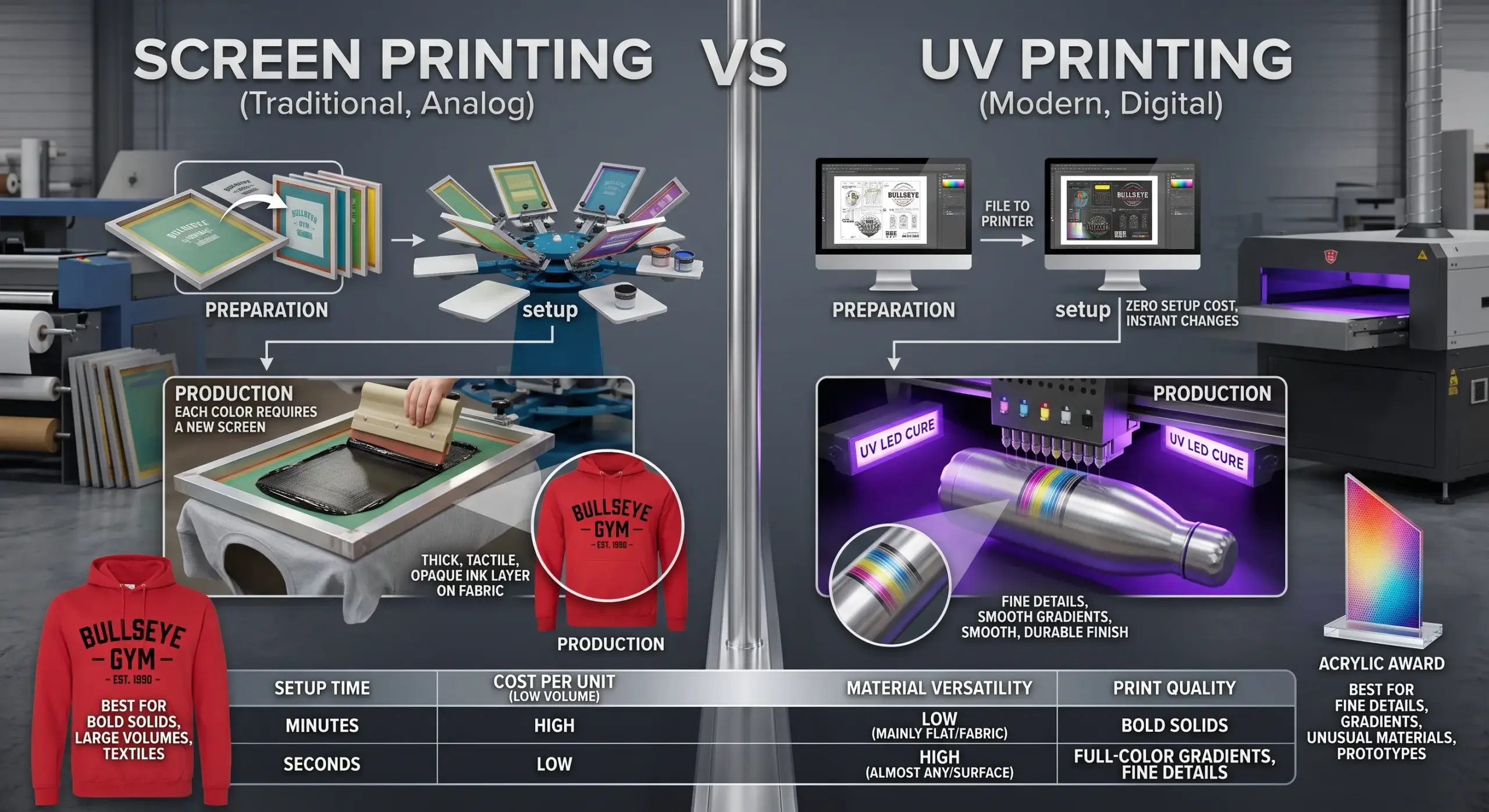
Screen printing is a traditional printing technique that uses a mesh screen, stencil, and squeegee to transfer ink onto a substrate. For each colour in the design, a separate screen is created with areas blocked off where ink should not pass through. Ink is then pushed through the open mesh onto the material, building up the design layer by layer.
How Screen Printing Works
Step 1: A screen is stretched over a frame.
Step 2: A stencil is created on the screen, blocking areas where ink should not pass.
Step 3: Ink is placed on the screen.
Step 4: A squeegee pushes the ink through the open mesh onto the substrate.
Step 5: The process is repeated for each colour in the design.
Step 6: The printed material is passed through a dryer to cure the ink.
Best Uses for Screen Printing
-
T-shirts, hoodies, and apparel
-
Fabric and textiles
-
Posters and paper products
-
Bags and tote bags
-
Large-volume orders (100+ pieces)
What Is UV Printing?
UV printing is a modern digital printing process that uses ultraviolet (UV) light to instantly cure ink as it is printed onto a surface. UV-curable inks contain photoinitiators that react to UV light, triggering a chemical reaction called photopolymerisation — transforming liquid ink into a solid, durable film in milliseconds.
How UV Printing Works
Step 1: Your digital design is prepared for printing.
Step 2: Using piezoelectric printheads, UV-curable ink is deposited onto the substrate.
Step 3: UV LED lamps instantly cure the ink through photopolymerisation.
Step 4: The print is touch-dry, scratch-resistant, and waterproof — ready for immediate handling.
Best Uses for UV Printing
-
Plastic, glass, metal, wood, and ceramic products
-
Pens, bottles, phone cases, and trophies
-
Corporate gifts and promotional merchandise
-
Signage, displays, and packaging
-
Low to medium volumes (1 to 1,000+ pieces)
Key Differences at a Glance
| Feature | Screen Printing | UV Printing |
|---|---|---|
| Print Quality | Bold, solid colours | Photorealistic, full-colour |
| Setup Cost | High — screens for each colour | Zero — digital process |
| Minimum Order | Usually 100+ pieces | 1 piece — no minimum |
| Material Compatibility | Fabric, paper, textiles | Almost any surface |
| Colour Capability | Limited — each colour requires a new screen | Full-colour — no limitations |
| Durability | Good on fabric | Excellent — scratch & fade-resistant |
| Waterproof | Limited | Yes — fully waterproof |
| Detail | Good — but limited | Exceptional — fine detail |
| Turnaround | 5-10 business days | Same-day available |
| Cost Per Unit | Low at scale | Competitive for small runs |
| Design Changes | Costly — new screens required | Free — instant digital changes |
Detailed Comparison
1. Print Quality
Screen Printing: Produces bold, vibrant, opaque colours that stand out on fabric. However, it is limited to solid colours and simple gradients. Complex designs with many colours require multiple screens, which increases cost and complexity.
UV Printing: Delivers photorealistic, full-colour prints with no colour limitations. UV printing captures gradients, fine details, and complex artwork with exceptional clarity. It produces sharp, crisp text and images that look like photographs.
2. Setup Costs
Screen Printing: Requires significant setup costs. Each colour in your design needs a separate screen, which costs KSh 1,500 – KSh 6,000 each. A 4-colour design may cost KSh 6,000 – KSh 24,000 in setup fees before printing a single item. Setup costs are high but amortised over large quantities.
UV Printing: Zero setup costs. UV printing is a digital process — your design is printed directly from a file. There are no screens, plates, or stencils to create. This makes UV printing economical for small batches and one-off items.
3. Minimum Order Quantities
Screen Printing: High setup costs make screen printing uneconomical for small orders. Most screen printers require minimum orders of 100+ pieces to make the setup worthwhile.
UV Printing: No minimum order. You can print a single item or thousands with the same quality and no setup fees. This makes UV printing ideal for small businesses, start-ups, and personalised products.
4. Material Compatibility
Screen Printing: Best suited for fabric and textiles — t-shirts, hoodies, caps, and bags. Can also print on paper, plastics, and metals, but requires specialised inks and equipment.
UV Printing: Prints on virtually any surface — plastic, glass, metal, wood, ceramic, acrylic, leather, paper, and more. UV printing can print on flat, curved, and irregular surfaces, including cylindrical objects like bottles and pens.
5. Colour Capability
Screen Printing: Each colour requires a separate screen. A 4-colour design needs 4 screens. Adding a 5th colour means creating another screen. This limits the number of colours you can use economically.
UV Printing: Full-colour — no colour limitations. UV printing supports CMYKWV (Cyan, Magenta, Yellow, Black, White, Varnish). You can print photorealistic images, gradients, and complex designs with unlimited colours. White ink allows printing on dark or transparent surfaces.
6. Durability
Screen Printing: Good durability on fabric. The ink bonds into the fibres and can withstand multiple washes. However, screen printing on hard surfaces is less durable.
UV Printing: Excellent durability — scratch-resistant, fade-proof, and waterproof. The UV-cured ink forms a hard, protective layer that withstands handling, washing, and outdoor conditions. UV prints on hard surfaces can last 2-5 years or more.
7. Turnaround Time
Screen Printing: 5-10 business days for design preparation, screen creation, printing, and drying. Setup time is significant, especially for multi-colour designs.
UV Printing: Same-day turnaround available. The instant curing means there is no drying time — prints are ready immediately. Digital setup means no waiting for screens.
8. Cost Per Unit
Screen Printing: Low cost per unit at scale. Setup costs are spread across hundreds or thousands of items. For quantities of 100+, screen printing becomes very cost-effective.
UV Printing: Competitive for small to medium runs. With zero setup costs, UV printing is economical for 1-500 pieces. Per-unit cost decreases with volume but remains competitive for medium runs.
9. Design Changes
Screen Printing: Costly and time-consuming to change a design. Each change requires creating new screens — starting the process from scratch. This makes revisions expensive.
UV Printing: Instant and free. Changing a design is as simple as updating the digital file. You can revise colours, text, or artwork instantly with no additional cost.
Cost Comparison
| Factor | Screen Printing | UV Printing |
|---|---|---|
| Setup Fees | KSh 1,500 – KSh 6,000 per colour | Zero |
| Setup Time | 1-3 days | Minutes |
| Cost for 1 Item | KSh 5,000 – KSh 20,000+ | KSh 100 – KSh 500 |
| Cost for 100 Items | KSh 200 – KSh 500 each | KSh 300 – KSh 800 each |
| Cost for 1,000 Items | KSh 50 – KSh 200 each | KSh 200 – KSh 500 each |
Prices are estimates and vary based on product, design, and supplier.
When to Choose Screen Printing
Screen printing is best when:
-
You need 100+ pieces (large-volume orders)
-
You are printing on fabric or textiles
-
Your design uses 1-4 solid colours
-
Your design does not require fine detail or gradients
-
You have time for a 5-10 day turnaround
-
You want bold, opaque colours on dark fabric
-
You are operating on a tight per-unit budget
Best Products for Screen Printing
-
T-shirts, hoodies, and caps
-
Bags and tote bags
-
Posters and paper products
-
Team uniforms and sportswear
-
Promotional apparel
When to Choose UV Printing
UV printing is best when:
-
You need 1-500 pieces (small to medium orders)
-
You are printing on hard surfaces (plastic, glass, metal, wood)
-
Your design is full-colour with gradients and fine detail
-
You need photorealistic quality
-
You want same-day turnaround
-
You don’t want setup costs
-
You may need to change designs easily
Best Products for UV Printing
-
Pens and promotional products
-
Bottles, mugs, and drinkware
-
Phone cases and electronics accessories
-
Awards, trophies, and plaques
-
Corporate gifts and merchandise
-
Signage, displays, and packaging
Screen Printing vs UV Printing: Which Should You Choose?
| Need | Recommendation |
|---|---|
| T-shirts and apparel (100+ pieces) | Screen Printing |
| T-shirts and apparel (small batch) | UV Printing (DTF) |
| Plastic, glass, metal, or wood products | UV Printing |
| Full-colour photorealistic designs | UV Printing |
| Large-volume fabric printing | Screen Printing |
| Corporate gifts and promotional products | UV Printing |
| Same-day turnaround | UV Printing |
| No minimum order | UV Printing |
| Bold, simple designs on fabric | Screen Printing |
| Customised or personalised items | UV Printing |
Frequently Asked Questions
What is the difference between screen printing and UV printing?
Screen printing uses mesh screens to push ink onto fabric or paper. UV printing uses UV light to instantly cure ink onto virtually any surface. Screen printing is best for large-volume fabric printing. UV printing is best for small to medium runs on hard surfaces.
Which is better — screen printing or UV printing?
It depends on your needs. Screen printing is better for large-volume fabric printing with simple designs. UV printing is better for small to medium runs on hard surfaces with full-colour, photorealistic designs.
Is UV printing cheaper than screen printing?
For small quantities (1-100 pieces), UV printing is cheaper due to zero setup costs. For large quantities (100+ pieces), screen printing becomes cheaper per unit.
Can UV printing replace screen printing?
UV printing has replaced screen printing for many applications — especially on hard surfaces and small runs. However, screen printing remains the better choice for large-volume fabric printing.
Can screen printing print full-colour designs?
Screen printing can print full-colour designs, but each colour requires a separate screen. This makes full-colour screen printing expensive and time-consuming.
Can UV printing print on fabric?
Yes, but not directly on all fabrics. UV printing works well on coated fabrics and banners. For soft fabrics like cotton, UV DTF transfers are a better option.
How long does screen printing take?
Screen printing typically takes 5-10 business days from design to delivery. Setup time for screens is significant.
How long does UV printing take?
UV printing offers same-day turnaround. The instant curing means no drying time, and digital setup means no waiting for screens.
Which method is more durable?
UV printing is more durable on hard surfaces — scratch-resistant, waterproof, and fade-proof. Screen printing is durable on fabric, with ink bonding into fibres.
Do I need a minimum order for screen printing?
Most screen printers require minimum orders of 100+ pieces to make setup costs worthwhile.
Do I need a minimum order for UV printing?
No — UV printing has no minimum order. You can print a single item or thousands.
Can I change my design after printing starts?
Screen printing does not allow changes once screens are made. UV printing allows instant changes to the digital file.
Which method is more environmentally friendly?
UV printing is more environmentally friendly. UV inks contain no volatile organic compounds (VOCs), while screen printing inks often contain solvents.
Why choose Krayon for UV printing?
We offer professional UV printing, no minimum order, same-day turnaround, Nairobi CBD location, competitive pricing, and expert design support.
Get Started with Krayon Today
Ready to experience professional UV printing in Nairobi? At Krayon, we combine technical expertise, premium quality, and exceptional customer service to deliver UV printing that impresses and lasts.
Contact Us
📱 WhatsApp us: +254 722 376 151
📍 Location: Lords House near Khoja Roundabout, Nairobi CBD, Kenya
📞 Phone: +254 722 376 151
📧 Email: sales@krayon.co.ke | info@krayone.com
🌐 Website: krayon.co.ke
Get a Quote
Ready to create professional UV prints for your business? Chat with us directly on WhatsApp for pricing, turnaround time, and minimum order quantities.
WhatsApp us: +254 722 376 151
No Comments