

08 Oct Sublimation Printing Process
The sublimation printing process is a digital printing method that uses heat to transfer dye onto polyester fabrics and polymer-coated surfaces. The word “sublimation” describes a scientific process where a solid turns directly into a gas without becoming liquid. In printing, sublimation inks are solid at room temperature. When heated to around 190–210°C, they turn into gas and penetrate the fibres of the material. When the heat is removed, the ink cools and solidifies, becoming permanently trapped inside. The result is a smooth, vibrant, photo-quality print that won’t crack, peel, or fade.
The process is used for a wide range of products, including mugs, t-shirts, flags, mousepads, and promotional items.
Step-by-Step Sublimation Printing Process
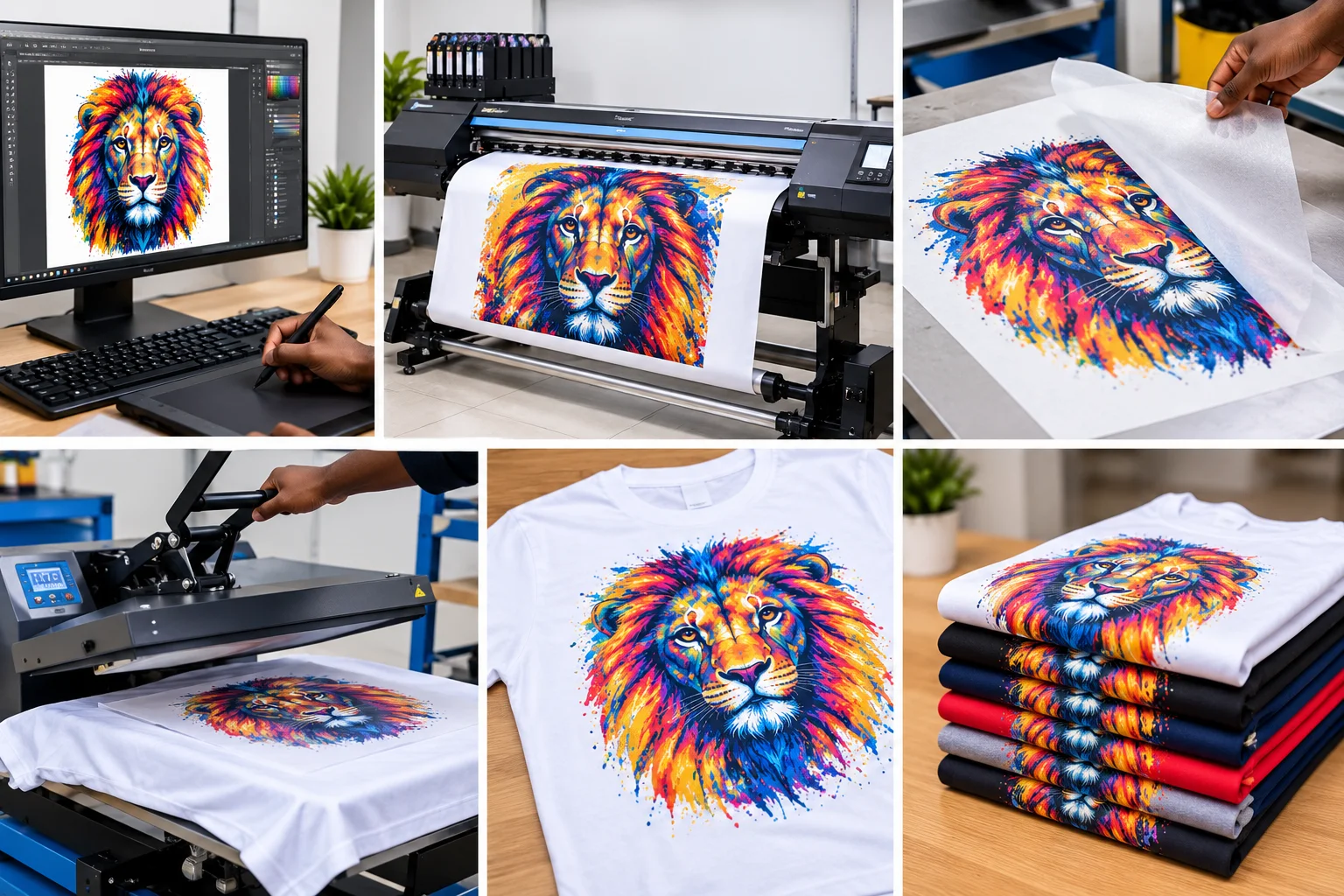
Here is the full sublimation printing process we follow at Krayon:
Step 1: Design Preparation
First, your artwork is prepared digitally. We ensure the design has the correct resolution (300 DPI or higher) and is in CMYK colour mode. The design is then mirrored (flipped horizontally) because the transfer process reverses the image. Our in-house design team can assist with artwork preparation, colour matching, and layout optimisation.
Step 2: Printing onto Transfer Paper
The mirrored design is printed onto special sublimation transfer paper using specialist sublimation inks. The paper is coated to hold the ink without absorbing it. We use high-quality transfer paper to ensure crisp, vibrant results.
Step 3: Heat Press Application
The printed transfer paper is placed face-down on the substrate (mug, t-shirt, flag, etc.). The item is then loaded into the appropriate heat press. The press applies three critical variables:
-
Temperature: 190–210°C
-
Time: 30–60 seconds (depending on the material)
-
Pressure: Medium-firm, applied evenly
During this window, the sublimation inks convert from solid to gas. The heat also opens the pores of the polyester fibres or polymer coating.
Step 4: Cooling and Bonding
When the heat press releases, the temperature drops rapidly. The material’s pores close, trapping the sublimation ink permanently inside. The design is now part of the material — it cannot be washed out, cracked, or peeled off.
Step 5: Quality Inspection
Every item is inspected for colour accuracy, print quality, and overall finish. We check for even coverage, sharp detail, and proper bonding. Only items that meet our standards are approved for delivery.
Step 6: Packaging and Delivery
Finished products are carefully packaged to prevent damage and prepared for collection or delivery. Same-day delivery is available for urgent orders in Nairobi.
Equipment Used in the Sublimation Printing Process
The sublimation printing process requires two main pieces of equipment:
Sublimation Printer
A specialised printer that uses sublimation inks to print the mirrored design onto transfer paper. We use industrial-grade sublimation printers at our Nairobi CBD workshop.
Heat Press
A machine that applies controlled heat and pressure to transfer the design from the paper onto the substrate. Different heat presses are used for different products:
-
Flatbed press – for t-shirts, mousepads, and flat fabric
-
Mug press – for mugs and cylindrical drinkware
-
3D vacuum press – for curved and irregular surfaces
-
Roll-to-roll calendar press – for large fabric runs
NB: We don’t sell machines. We use our machines to provide sublimation printing services for clients.
Sublimation Printing Process by Product Type
The process varies slightly depending on the product being printed:
Mugs
-
Design printed on transfer paper
-
Paper wrapped around mug and secured
-
Mug placed in mug press for 30–60 seconds at 180–200°C
-
Mug removed, paper peeled off, and allowed to cool
T-Shirts
-
Design printed on transfer paper
-
Paper placed face-down on the t-shirt
-
Flatbed press applies heat and pressure for 30–60 seconds
-
Paper peeled off while hot or cold
Flags and Fabric
-
Design printed on transfer paper or directly onto fabric (roll-to-roll)
-
Fabric and paper fed through calendar press
-
Heat and pressure transfer the ink continuously
Hard Goods (Mousepads, Tiles, etc.)
-
Design printed on transfer paper
-
Paper placed on the coated surface
-
Flatbed press applies heat and pressure
Sublimation Printing Process Pricing in Nairobi
| Product | Pricing |
|---|---|
| Mug Sublimation Printing | From KSh 100 |
| T-Shirt Sublimation Printing & Branding | From KSh 150 |
| Sublimation Printing on Fabric (Per Meter) | From KSh 350 |
| Custom 3D Sublimation T-Shirt | From KSh 1,800 |
| Long Sleeve 3D Sublimation T-Shirt | From KSh 2,000 |
Prices depend on material, size, design complexity, and quantity. Contact us for an exact quote.
NB: We don’t stock the t-shirts — you bring your own, and we print and brand for you.
Why Choose Krayon for the Sublimation Printing Process in Nairobi?
Industrial-Grade Equipment
We use professional sublimation printers and heat presses capable of handling high-volume production runs with consistent, vibrant results.
In-House Production
We handle the entire process at our Nairobi CBD workshop — from design to printing to transfer. This gives you faster turnaround, consistent quality, and better pricing.
Free Design Assistance
Our in-house design team assists with artwork preparation, colour matching, and layout optimisation. Design assistance is free.
No Minimum Order
Order a single item or thousands. We treat every order with the same care and attention.
Same-Day Delivery in Nairobi
Urgent order? We deliver same-day across Nairobi.
Nairobi CBD Location
Visit us at Lords House near Khoja Roundabout for samples, design advice, and order collection.
Frequently Asked Questions
1. What is the sublimation printing process?
The sublimation printing process is a digital printing method that uses heat to transfer dye onto polyester fabrics and polymer-coated surfaces. The ink turns into gas and bonds with the material, creating durable, full-colour prints.
2. What are the steps in the sublimation printing process?
The steps are: design preparation, printing onto transfer paper, heat press application, cooling and bonding, quality inspection, and packaging.
3. What equipment is needed for sublimation printing?
You need a sublimation printer and a heat press (flatbed, mug press, 3D vacuum press, or roll-to-roll calendar press, depending on the product).
4. How long does the sublimation printing process take?
The heat press application takes 30–60 seconds per item. Overall turnaround depends on the order size. Same-day delivery is available for urgent orders.
5. What temperature is used in sublimation printing?
The process uses temperatures between 190–210°C for most substrates, with 180–200°C for mugs.
6. How much does sublimation printing cost?
Pricing starts from KSh 100 for mugs, KSh 150 for t-shirts, and KSh 350 per meter for fabric. Contact us for a quote.
7. Do you sell sublimation machines?
No, we don’t sell machines. We use our machines to provide sublimation printing services for clients.
8. Do you have a minimum order?
No minimum order — we handle single items to bulk corporate orders.
9. Do you offer design services?
Yes. Our in-house design team assists with artwork preparation and colour matching. Design assistance is free.
10. Can I get a sample before placing a bulk order?
Yes. We can produce a single sample for your approval before you commit to a bulk order.
11. Do you deliver sublimation printed items outside Nairobi?
Yes. We deliver across Kenya. Delivery charges may apply for locations outside Nairobi.
12. Why choose Krayon for the sublimation printing process in Nairobi?
We offer industrial-grade equipment, in-house production, free design assistance, no minimum order, same-day delivery in Nairobi, Nairobi CBD location, and competitive pricing.
Get a Quote
Ready to get professional sublimation printing in Nairobi, Kenya? Chat with us directly on WhatsApp for pricing, turnaround time, and design assistance.
WhatsApp us: +254 722 376 151
Krayon Enterprises — Lords House near Khoja Roundabout, Nairobi CBD, Kenya | Phone: +254 722 376 151 | Email: sales@krayon.co.ke | info@krayone.com | krayon.co.ke
No Comments