
08 Oct Sublimation Printing vs DTF
Sublimation Printing vs DTF: Which Method Is Right for Your Custom Apparel?
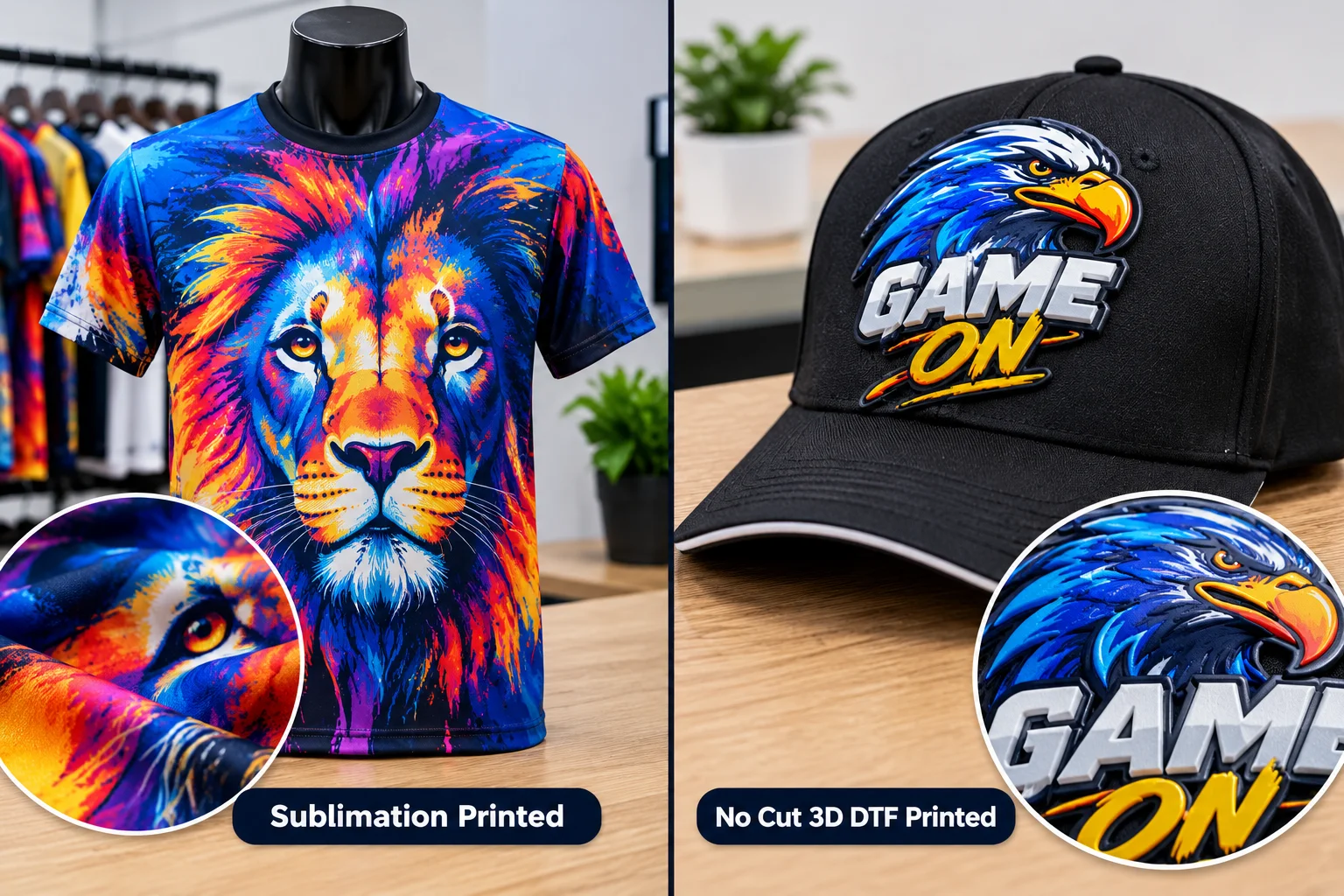
Sublimation printing is a digital printing process that uses heat to transfer dye into polyester-based fabrics and polymer-coated surfaces. The solid ink turns into gas at approximately 190–210°C and penetrates the fibres. When cooled, the ink is permanently trapped inside — creating a smooth, vibrant print that becomes part of the material itself. The print feels like part of the fabric, with zero hand feel, because the dye bonds at a molecular level. Sublimation is limited to polyester or polyester-blend fabrics (minimum 65% polyester) and light-coloured materials, as the ink is transparent and requires a white base to show colour.
What Is DTF Printing?
DTF (Direct-to-Film) printing is a digital transfer-based process. Your design is printed onto a special PET film using water-based ink, coated with adhesive powder, cured, and then heat-pressed onto the garment. The film is peeled away, leaving the ink and adhesive bonded to the fabric’s surface. DTF works on virtually any fabric — cotton, polyester, blends, nylon, denim, canvas, and fleece — and produces excellent results on dark garments thanks to an opaque white ink underbase. The print sits on top of the fabric, giving it a slightly thicker hand feel that softens after washing.
Key Comparison: Sublimation Printing vs DTF
| Feature | Sublimation Printing | DTF Printing |
|---|---|---|
| Fabric Compatibility | Polyester & polymer-coated surfaces only (min. 65% polyester) | Cotton, polyester, blends, nylon, denim, canvas, fleece |
| Dark Garments | Not possible — dye is transparent | Excellent — opaque white underbase with no pretreatment |
| Hand Feel | Zero hand feel — dye becomes part of the fibre | Medium — a film layer sits on the fabric and softens after washing |
| Durability | Lasts the life of the garment — no cracking, peeling, or surface wear | 50–100+ washes with quality ink, powder, and correct pressing |
| White Ink | Not possible (transparent ink) | Yes — prints opaque white for dark fabrics |
| All-Over Printing | Excellent — true edge-to-edge on polyester | Limited by film size and transfer area |
| Best For | Polyester sportswear, jerseys, all-over prints, mugs, hard goods | Mixed-fabric shops, dark garments, cotton t-shirts, small to medium runs |
| Setup Time | 5–10 minutes | 5–10 minutes; no fabric pretreatment |
| Production Speed | 30–50+ items per hour | 20–40 shirts per hour |
Fabric Compatibility: The Biggest Difference
The most important distinction between s Sublimation Printing vs DTF is fabric compatibility.
Sublimation only works on polyester and polymer-coated surfaces. The dye chemically bonds with polyester molecules — it does not bond with cotton, nylon, or other natural fibres. If you print sublimation on cotton, the image will look faded from the moment it comes off the press and will wash out almost completely.
DTF works on virtually any fabric. Cotton, polyester, blends, nylon, denim, canvas, fleece — DTF handles them all. This makes DTF the clear winner for businesses that print on mixed fabric types or need one solution for every order.
Verdict: If your orders cross fabric types — cotton t-shirts alongside polyester jerseys — DTF is the more versatile choice. If you specialise in polyester sportswear and all-over prints, sublimation delivers superior results.
Dark Garments: DTF Wins
Sublimation ink is transparent. It has no white pigment. When you print on a dark fabric, the ink becomes invisible or muddy because there is no white background to reflect the colours. This is why standard sublimation only works on white or light-coloured polyester.
DTF printing uses a white ink underbase that sits beneath your design. This allows colours to remain vibrant and visible on black, navy, or any dark fabric. DTF produces excellent, opaque results on dark garments with no fabric pretreatment required.
Verdict: If you need to print on dark fabrics — and most apparel brands do — DTF is the only practical choice.
Hand Feel and Texture
Sublimation offers the best hand feel of any printing method. Because the dye becomes part of the fabric, there is zero hand feel — no raised texture, no plastic layer. The print feels exactly like the fabric itself. This makes sublimation ideal for sportswear, performance wear, and any garment where comfort is paramount.
DTF prints sit on top of the fabric. There is a film layer that you can feel when you touch the print. However, with proper pressing and after washing, the feel softens considerably. DTF has a medium hand feel — noticeably thicker than sublimation but far softer than heat transfer vinyl.
Verdict: For sportswear and performance apparel, sublimation’s zero hand feel is unmatched. For cotton t-shirts and hoodies, DTF provides an acceptable, comfortable feel that softens over time.
Durability and Wash Resistance
Sublimation is the most durable printing method available. Because the dye is embedded inside the fabric fibres, there is no surface layer to crack, peel, or fade. Sublimation prints last the entire life of the garment under normal conditions. Research confirms that sublimation exhibits the highest ink adhesion and washing durability with minimal colour changes on fabric.
DTF prints are also highly durable, typically lasting 50–100+ washes with quality ink, correct adhesive powder, and proper pressing. However, DTF prints can experience edge lifting or slight cracking under very aggressive use or high-heat washing, especially if pressing or adhesive quality is subpar. With good technique, DTF prints hold up well for everyday wear.
Verdict: Sublimation offers superior long-term durability with zero risk of cracking or peeling. DTF is durable enough for everyday use but requires careful pressing and washing to maximise longevity.
Color Vibrancy and Print Quality
Both methods produce vibrant, full-colour, photo-quality prints with no colour limitations. Sublimation has the advantage of colour being embedded in the fibres, which makes it resistant to fading. DTF prints sit on top of the fabric, so colours appear slightly more saturated on the surface but may be more vulnerable to abrasion over time.
For detailed, all-over designs, sublimation is superior. For photorealistic prints on cotton and dark fabrics, DTF is the better choice.
Verdict: Both methods deliver excellent colour reproduction. Sublimation wins for all-over designs and long-term colour stability. DTF wins for dark fabrics and cotton garments.
Sublimation Printing vs DTF Cost Comparison
| Cost Factor | Sublimation | DTF |
|---|---|---|
| Materials Cost Per Print | $0.30–$1.00 (ink + transfer paper) | $0.50–$1.80 (film is largest consumable) |
| Cost Per Shirt | $2.50–$6 per shirt | $3–$7 per shirt |
| Startup Equipment | $1,000–$3,000 for full DIY setup | $1,500–$6,000 for entry in-house |
| Specialty Blanks | Required (polyester & coated items) | None — works on standard blanks |
| Minimum Order | 1 piece | 1 piece |
Sublimation has a lower entry point and lower materials cost. DTF requires a higher initial investment but delivers greater earning potential over time due to its versatility.
Verdict: For start-ups and hobbyists, sublimation is the more affordable entry point. For commercial shops serving diverse client needs, DTF’s higher upfront cost is justified by its broader application range.
When to Choose Sublimation Printing
Choose sublimation when you need:
-
All-over, edge-to-edge prints on polyester sportswear and jerseys
-
Zero hand feel for performance wear and athletic garments
-
Maximum durability — prints that last the life of the garment
-
Printing on polymer-coated hard goods — mugs, mousepads, tumblers, phone cases
-
Photo-quality, full-colour designs on light-coloured polyester
-
Fast production speed — 30–50+ items per hour
Best for: Sports jerseys, marathon kits, team uniforms, performance wear, all-over print t-shirts, mugs, and promotional hard goods.
When to Choose DTF Printing
Choose DTF when you need:
-
Versatility across fabric types — cotton, polyester, blends, nylon, denim
-
Vibrant prints on dark garments — black, navy, and hi-vis workwear
-
Cotton t-shirts and hoodies — sublimation cannot print on 100% cotton
-
Photorealistic designs with fine detail on any fabric colour
-
Short to medium runs with no screen setup or minimum order
-
Reflector jackets and safety wear where dark backgrounds are common
Best for: Cotton t-shirts, hoodies, reflector jackets, mixed-fabric orders, dark garments, and workwear.
Which Method Is Right for You?
| Your Need | Recommended Method |
|---|---|
| All-over print polyester jerseys | Sublimation |
| Cotton t-shirts (white or light) | DTF |
| Cotton t-shirts (black or dark) | DTF |
| Mugs, mousepads, hard goods | Sublimation |
| Reflector jackets and safety wear | DTF |
| Performance sportswear (zero feel) | Sublimation |
| Mixed fabric orders | DTF |
| Maximum durability & wash resistance | Sublimation |
| Printing white on dark fabric | DTF |
| Photo-quality prints on any colour fabric | DTF |
Why Choose Krayon for Both Sublimation and DTF Printing in Nairobi?
At Krayon Enterprises, located at Lords House near Khoja Roundabout in Nairobi CBD, we offer both sublimation printing and DTF printing — so you don’t have to choose one method or visit multiple vendors.
Industrial-Grade Equipment
We use professional sublimation printers and DTF equipment capable of handling high-volume production runs with consistent, vibrant results. Our machines are the best for both dye sublimation and DTF printing.
In-House Production
We handle the entire process at our Nairobi CBD workshop — from design to printing to transfer. This gives you faster turnaround, consistent quality, and better pricing.
Free Design Assistance
Our in-house design team assists with artwork preparation, colour matching, and layout optimisation for both printing methods. Design assistance is free.
No Minimum Order
Order a single item or thousands. We treat every order with the same care and attention.
Same-Day Delivery in Nairobi
Urgent order? We deliver same-day across Nairobi.
NB: For DTF printing, we don’t stock the garments — you bring your own items, and we print and brand them for you.
Sublimation Printing vs DTF Frequently Asked Questions
1. What is the difference between sublimation printing and DTF printing?
Sublimation uses heat to infuse dye into polyester fibres — the ink becomes part of the fabric. DTF prints onto a film, applies adhesive powder, and heat-presses the transfer onto the garment. Sublimation works only on polyester; DTF works on virtually any fabric.
2. Can sublimation print on cotton?
No. Sublimation requires a minimum of 65% polyester content. For cotton t-shirts, DTF printing is the correct choice.
3. Can DTF print on dark fabrics?
Yes. DTF uses a white ink underbase, so colours remain vibrant and visible on black, navy, and other dark fabrics.
4. Which method is more durable — sublimation or DTF?
Sublimation is the most durable method available. Because the dye is embedded inside the fibres, there is no surface layer to crack, peel, or fade. DTF is also durable — typically lasting 50–100+ washes — but can experience edge lifting under aggressive washing.
5. Which method has a better hand feel?
Sublimation has zero hand feel — the print feels like part of the fabric. DTF has a medium hand feel — you can feel the film layer initially, but it softens after washing.
6. Can I use sublimation on mugs and hard goods?
Yes. Sublimation works on polymer-coated mugs, mousepads, tumblers, phone cases, and other coated hard surfaces. DTF is primarily for textiles.
7. Which method is cheaper — sublimation or DTF?
Sublimation has a lower entry point and lower materials cost. DTF requires a higher initial equipment investment but delivers greater versatility across fabric types.
8. Can I print all-over designs with sublimation?
Yes. Sublimation allows for true edge-to-edge, all-over designs on polyester fabric with no visible seams.
9. Do you offer both sublimation and DTF printing in Nairobi?
Yes. Krayon offers both sublimation printing and DTF printing at our Nairobi CBD workshop. WhatsApp +254 722 376 151 for a quote.
10. Do you stock the garments for DTF printing?
No. For DTF printing, we don’t stock the garments — you bring your own items, and we print and brand them for you.
11. What is the turnaround time for sublimation and DTF printing?
Same-day delivery available for urgent orders in Nairobi.
12. Do you have a minimum order for sublimation or DTF printing?
No minimum order — we handle single items to bulk corporate orders.
Get a Quote
Ready to get professional sublimation printing or DTF printing in Nairobi, Kenya? Chat with us directly on WhatsApp for pricing, turnaround time, and design assistance.
WhatsApp us: +254 722 376 151
Krayon Enterprises — Lords House near Khoja Roundabout, Nairobi CBD, Kenya | Phone: +254 722 376 151 | Email: sales@krayon.co.ke | info@krayone.com | krayon.co.ke
No Comments